Updated 8 June 2026 · 7 min read
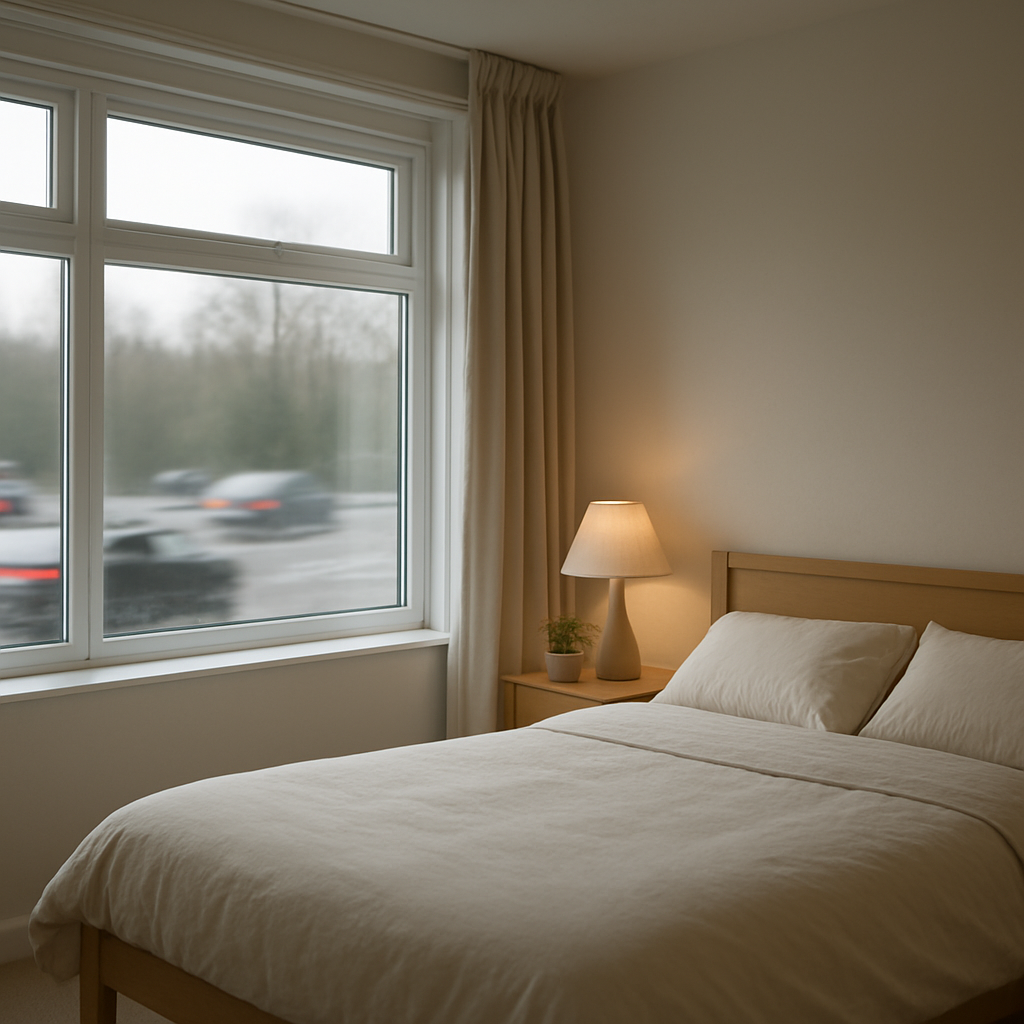
If you've tried curtains, draught strips and double glazing and you can still hear the road — secondary glazing is the upgrade that actually works. Here's how to specify it correctly.
Why standard double glazing doesn't stop traffic noise
Most homeowners assume double glazing solves noise — it doesn't. Standard A-rated double glazing reduces external noise by 28–32 dB. That's because the two panes are bonded together with a 16–20mm spacer bar, which transmits sound vibrations directly from outer pane to inner pane.
Secondary glazing achieves 45–54 dB reduction because the inner pane is mounted in a completely separate frame with a 100–200mm air gap. Sound waves lose energy crossing that gap and have nothing to vibrate through.
The dB reduction table
Real-world noise reduction figures for different secondary glazing configurations:
| Configuration | Air gap | Glass | dB reduction |
|---|---|---|---|
| Single + secondary (slim) | 80mm | 4mm float | 38 dB |
| Single + secondary (standard) | 100mm | 4mm float | 42 dB |
| Single + secondary (deep) | 150mm | 6mm toughened | 48 dB |
| Acoustic spec (recommended) | 150mm | 6.4mm acoustic laminated | 51 dB |
| Heavy acoustic spec | 200mm | 10mm acoustic laminated | 54 dB |
What 50 dB actually sounds like
Decibel reductions are logarithmic, which makes them hard to visualise. Here's what real noise sources sound like after secondary glazing treatment:
| Noise source | Outside (dB) | Inside after 50 dB reduction |
|---|---|---|
| Suburban traffic | 65 dB | 15 dB (silence) |
| Main A-road | 75 dB | 25 dB (whisper) |
| HGV passing | 85 dB | 35 dB (library) |
| Heathrow approach | 90 dB | 40 dB (quiet office) |
| Pub closing time | 70 dB | 20 dB (rural night) |
Specification by noise problem
Suburban road noise
For typical residential streets with intermittent traffic, a 100mm air gap with 4mm or 6mm glass is sufficient. Expect a 40–44 dB reduction and a transformed sleeping environment. Typical cost: £550–£700 per window.
Main road / A-road
Continuous traffic noise needs a deeper air gap. Target 150mm with 6mm toughened glass or 6.4mm acoustic laminated. Expect 48–51 dB reduction. Typical cost: £700–£850 per window.
Flight path (Heathrow, City, Stansted)
Aircraft noise is predominantly low frequency, which standard glass transmits efficiently. Specify 10mm acoustic laminated glass with the deepest possible air gap (180–200mm where the reveal allows). Expect 52–54 dB reduction. Typical cost: £850–£950 per window.
Pub, club or entertainment venue nearby
Bass and music noise is the hardest to block. Use 6.4mm or 10mm acoustic laminated glass (the PVB interlayer is critical here), a 150mm+ air gap, and ensure the perimeter seals are premium-grade compression seals not standard brush seals. Typical cost: £800–£950 per window.
Rail noise
Rail noise is mixed frequency with sharp peaks during train passes. The same spec as flight path treatment works well: 10mm acoustic laminated, 200mm air gap. For properties within 50m of the track, also consider isolation mounts on the subframe to prevent structural vibration transfer.
Why the seals matter as much as the glass
A common installation failure: premium glass paired with cheap brush seals. Brush seals leak high-frequency noise around the perimeter, undoing the acoustic performance of the glass. Specify compression seals or premium EPDM gaskets. We use Wakefield/Q-Lon perimeter seals on all acoustic installations.
Real Presswarm installations
Recent acoustic projects we've completed:
- Hounslow, TW3 — Heathrow approach path.4-bed semi, 10 windows. 10mm acoustic laminated, 180mm air gap. Customer reported "completely transformed" sleep quality. Cost: £8,400.
- Hackney, E8 — main road frontage. Victorian terrace, 6 front-facing sash windows. Vertical sliding secondary with 6.4mm acoustic glass. Cost: £4,950.
- Hertford town centre — pub noise. Apartment above a bar. 4 windows, 10mm acoustic, 200mm air gap. Reduced 95 dB closing-time noise to inaudible. Cost: £3,600.
Get a free acoustic assessment
We'll measure your existing noise problem with a calibrated dB meter and specify the exact glass and air gap you need. No commission, no upselling.